


Securing Financing: Building a Funding Plan That Actually Works
Most franchise investors utilize financing to invest in a franchise opportunity. However, securing funding involves much more than having good credit and sufficient collateral.
The real question isn’t simply, “Can I get approved?” It’s “Can I fund this business in a way that gives me room to succeed?”
Getting Approved Is Only the Beginning
A lender may be comfortable with the numbers, but that doesn’t necessarily mean the funding structure is comfortable for you.
When evaluating financing, we want to look beyond the initial investment and consider the bigger picture:
- How much working capital will the business need?
- What happens if revenue takes longer to build than expected?
- Is there enough cash available for unexpected expenses?
- What happens if you make a few normal mistakes along the way?
- How much personal income will you need while the business gets established?
- Will your financing structure leave you financially stretched every month?
These questions matter because businesses rarely follow the perfect trajectory laid out in a spreadsheet.
Give Yourself Room to Operate
One of the biggest mistakes franchise investors can make is using nearly all of their available capital just to get the doors open.
Getting funded and opening the business is one milestone. Having enough financial breathing room to operate while you build the business is another.
A strong funding plan should account for working capital, slower-than-expected traction, unexpected expenses, and the normal friction that comes with starting a business.
That doesn't mean you should overfund every opportunity. It means you should understand how much capital you realistically need and structure your financing accordingly.
The Goal Isn't to Maximize the Loan
More financing isn't automatically better, either.
The goal is to find the right balance between having enough capital to operate confidently and taking on a level of debt that makes sense for your overall financial situation.
Your business should have room to grow without your personal finances becoming unnecessarily restrictive.
Because let's be honest: a funding plan that looks great on paper but makes your personal life oddly tense every time the calendar turns isn't really a great funding plan.
Look at the Whole Financial Picture
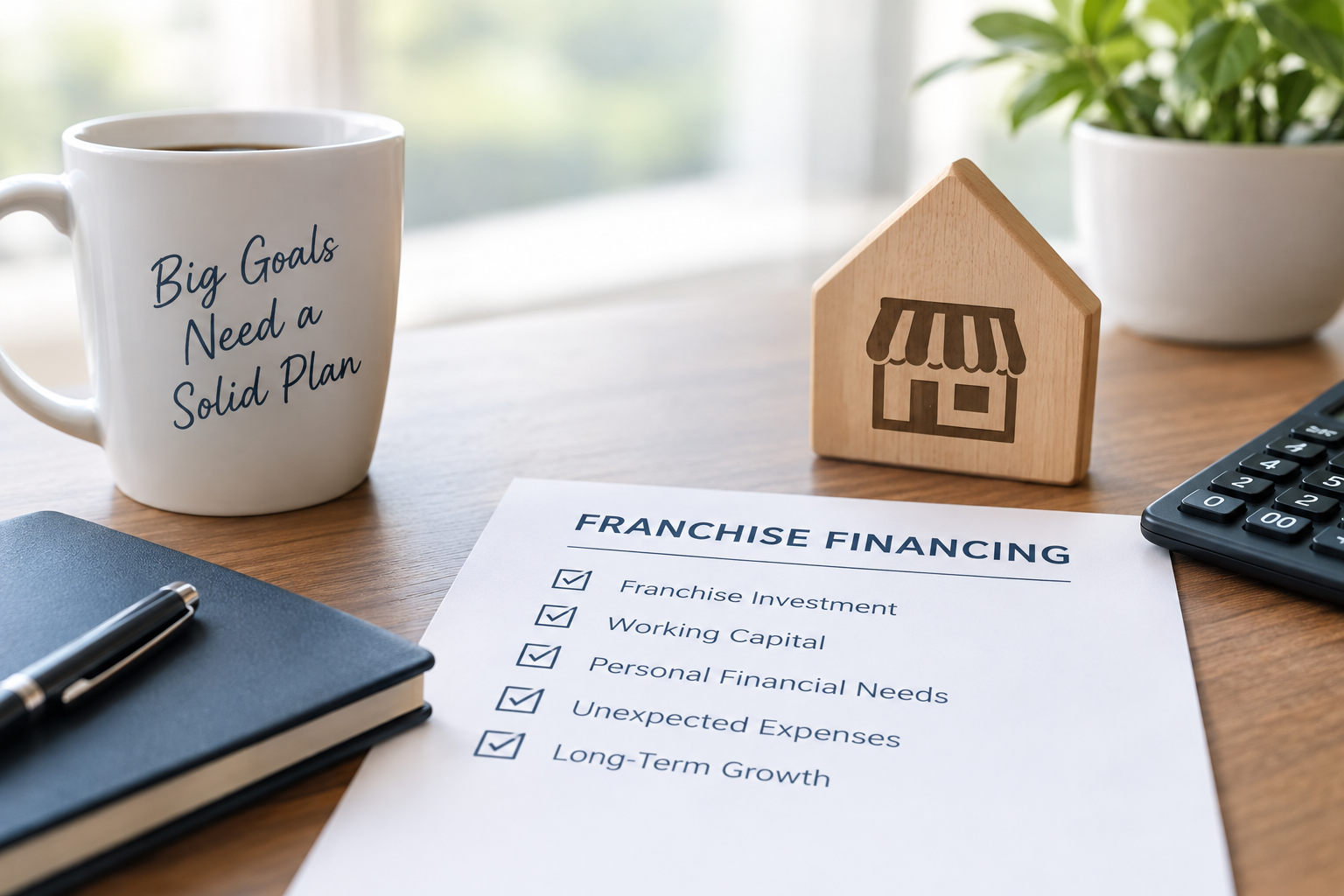
Before moving forward with a franchise, we encourage candidates to look at the complete financial picture—not just the franchise fee or the amount required to open.
That can include:
Initial Investment
Franchise fees, equipment, vehicles, technology, buildout, deposits, professional fees, and other startup costs.
Working Capital
The cash needed to cover expenses while the business establishes a customer base and reaches a sustainable level of revenue.
Personal Financial Needs
Your household still has bills while the business gets off the ground. Your funding strategy should take your personal financial requirements into consideration.
Financing Costs
Interest, loan fees, repayment terms, and other costs can significantly affect your overall financial commitment.
Contingency
Things don't always go according to plan. Having additional reserves can give you options when reality doesn't perfectly match the projections.
A Strong Funding Plan Creates Options
The best funding conversation isn't just about finding someone willing to lend you money.
It's about understanding how much capital you need, where it should come from, how much debt you're comfortable carrying, and how the entire structure fits into your personal financial goals.
A funding plan should support the business through ordinary friction—not just through a polished projection.
If the numbers only feel comfortable in a clean, best-case scenario, the structure probably deserves another look.
The goal is to close on the franchise and still have enough financial breathing room to operate like a rational person afterward.
At TruePath Franchise Coaching, we help prospective franchise owners think through the investment, funding requirements, and overall financial picture before they make a commitment. Our goal isn't simply to help you find a franchise you can buy. It's to help you determine whether the opportunity and the financial structure make sense for you.
9/18/2026 8:14:30 AM
